
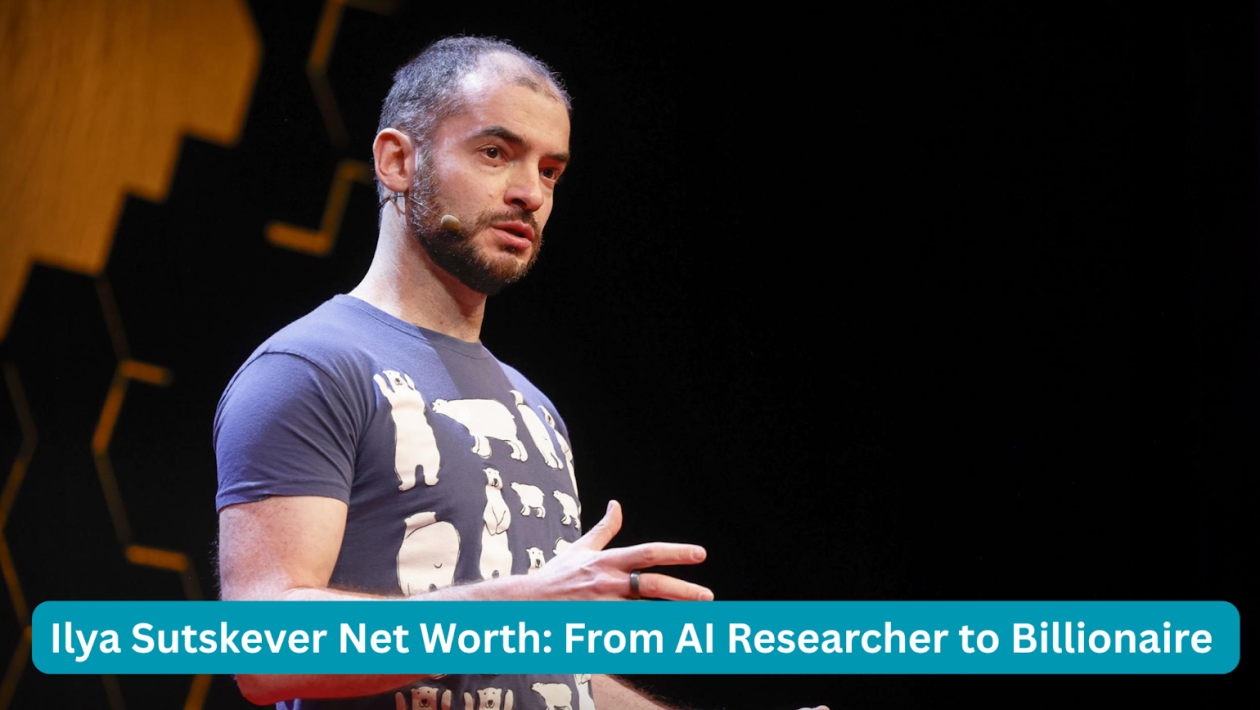
Ilya Sutskever is one of the people who helped shape the artificial intelligence boom long before ChatGPT became a household name. His career includes breakthrough research with Geoffrey Hinton, work at Google Brain, the founding of OpenAI, and the launch of Safe Superintelligence Inc. (SSI).
His influence in AI has also translated into substantial financial success through his involvement in private technology companies. In this article, we’ll look at Ilya Sutskever net worth, his early life, education, career, OpenAI stake, SSI, major AI contributions, awards, and the different sources behind his wealth.
| Attribute | Details |
| Full Name | Ilya Sutskever |
| Birth Date | December 8, 1986 |
| Age | 39 years old |
| Birthplace | Gorky, Soviet Union (now Nizhny Novgorod, Russia) |
| Nationality | Canadian-Israeli |
| Profession | Computer Scientist, AI Researcher, Entrepreneur |
| Education | University of Toronto |
| Joined OpenAI | 2015 |
| Left OpenAI | 2024 |
| Current Company | Safe Superintelligence Inc. (SSI) |
| SSI Role | Co-Founder & CEO |
| Net Worth | $13.8 Billion |
| Major Recognition | Royal Society Fellow, TIME100 AI |
Ilya Sutskever Net Worth in 2026
Ilya Sutskever net worth in 2026 is estimated as $13.8 billion. The figure is largely linked to his equity in private AI companies, particularly OpenAI, rather than conventional employment income.
The strongest publicly reported figure is his OpenAI stake. During testimony in May 2026, Sutskever said his stake in the company was worth about $7 billion, making him one of OpenAI’s largest individual shareholders.
His SSI involvement adds another potential source of wealth. The startup reached a reported $32 billion valuation in 2025, although Sutskever’s exact ownership percentage has not been publicly disclosed.
Because these are private-company holdings, the estimated figure should be viewed as an assessment rather than a publicly audited personal balance sheet.
Who is Ilya Sutskever?
Ilya Sutskever is a computer scientist and AI researcher known for his work in deep learning and his role in building OpenAI.
Born in Russia and raised partly in Israel, he later moved to Canada and studied at the University of Toronto. There, he worked under Geoffrey Hinton, one of the pioneers of modern neural-network research.
Sutskever went on to co-found DNNResearch, work at Google Brain, and become a founding member of OpenAI in 2015. He later served as OpenAI’s chief scientist.
After leaving OpenAI in 2024, he co-founded SSI, a company focused specifically on developing safe superintelligence. In 2025, he also became the company’s CEO following Daniel Gross’s departure.
Early Life and Education
Sutskever developed an interest in computers at a remarkably young age. According to the University of Toronto, he first became fascinated with computing when he was five years old. His family later moved from Israel to Canada, where his academic career took shape.
He entered the University of Toronto’s mathematics program after Grade 11 and earned an honours bachelor’s degree in mathematics in 2005. He continued at the university, completing a master’s degree and PhD in computer science.
His doctoral research was supervised by Geoffrey Hinton. Working in Hinton’s machine-learning group placed Sutskever at the center of research that would later help drive the deep-learning revolution.
That background became the foundation for his later work at DNNResearch, Google Brain, OpenAI, and eventually SSI.
Ilya Sutskever’s Career Journey
| Year | Career Milestone |
| 2005 | Earned an honours bachelor’s degree in mathematics from the University of Toronto |
| 2013 | Completed his PhD in computer science |
| 2013 | Joined Google Brain after DNNResearch was acquired |
| 2015 | Co-founded OpenAI |
| 2015–2024 | Served as OpenAI’s research director and later chief scientist |
| 2024 | Co-founded Safe Superintelligence Inc. |
| 2025 | Became SSI’s CEO |
His career progressed from academic research to some of the most valuable AI companies in the world. The University of Toronto credits him with major contributions to deep learning, sequence-to-sequence models, generative AI, and AI safety.
How Did Ilya Sutskever Build His Wealth?
Sutskever’s fortune was not built through a traditional executive salary. His biggest financial opportunity came from joining OpenAI at an early stage and holding valuable equity as the company grew.
Before OpenAI, he worked at Google Brain and had already established himself as a leading AI researcher. During 2026 testimony, he said Google had offered him compensation worth $6 million per year to stay rather than leave for OpenAI.
He chose the startup opportunity instead.
That decision became financially significant as OpenAI’s value increased dramatically. His reported $7 billion OpenAI stake now forms the clearest publicly documented component of his wealth. His SSI position could represent another substantial asset, although its exact value to him remains private.
Ilya Sutskever’s OpenAI Stake
Sutskever joined OpenAI at its beginning in 2015 and became one of its most important technical leaders. He eventually served as chief scientist and helped guide the company’s research into increasingly capable AI systems.
His early involvement is particularly important to his finances. Rather than joining OpenAI after it had already become a major technology company, he was part of its founding research team.
In May 2026, Sutskever disclosed during testimony in the Musk-OpenAI trial that his stake in OpenAI was worth approximately $7 billion. Bloomberg described him as one of the company’s largest individual shareholders.
That stake should not be confused with liquid cash. OpenAI remains a private company, so the value represents private equity rather than money sitting in a bank account.
Why Did Ilya Sutskever Leave OpenAI?
Sutskever left OpenAI in May 2024 after almost a decade with the organization. His departure followed the leadership crisis surrounding Sam Altman’s temporary removal as CEO in November 2023.
Sutskever had participated in the board’s decision to remove Altman but later supported his return. During testimony in 2026, he said he had acted because he believed the organization was at risk and that he ultimately did not want OpenAI to be destroyed.
His departure did not signal a move away from AI. Instead, he soon launched a new venture focused on a problem he had become increasingly concerned about: building advanced AI while keeping safety ahead of capability development. That company became Safe Superintelligence Inc.
Safe Superintelligence Inc. (SSI)
Sutskever co-founded Safe Superintelligence Inc. in 2024 with Daniel Gross and Daniel Levy. The company has a deliberately narrow mission: developing safe superintelligence.
SSI differs from many AI startups because it has not centered its strategy on launching a consumer chatbot or building a broad range of commercial products. Its stated focus is the development of highly capable AI systems while keeping alignment and safety at the center.
The approach has attracted extraordinary investor interest.
SSI reportedly raised another $2 billion at a $32 billion valuation in 2025, despite remaining largely secretive about its technology and having no conventional consumer product. Sutskever later became SSI’s CEO after Gross left the company in June 2025.
How Much is SSI Worth?
Safe Superintelligence was reportedly valued at $32 billion following its 2025 funding round. The company had previously raised about $1 billion, making its rapid increase in valuation particularly striking.
The valuation is important when discussing Sutskever’s wealth, but you should not treat the entire $32 billion as his personal fortune.
A company’s valuation represents the estimated worth of the whole business. The founder’s personal wealth depends on their ownership percentage, which has not been publicly disclosed in enough detail for an exact calculation.
SSI also received further backing from Nvidia in July 2026. Nvidia announced a long-term strategic partnership and investment designed to expand SSI’s computing capacity by an order of magnitude. The deal could make SSI even more valuable, potentially increasing the value of Sutskever’s stake.
Ilya Sutskever’s Major AI Contributions
Sutskever’s financial success is closely connected to his scientific reputation. His work predates the current generative-AI frenzy by years.
AlexNet
Sutskever worked with Alex Krizhevsky and Geoffrey Hinton on AlexNet, the neural network that produced a landmark result in the 2012 ImageNet competition. The project helped demonstrate the power of deep learning at scale.
Sequence-to-Sequence Learning
At Google, Sutskever co-developed sequence-to-sequence models with Oriol Vinyals and Quoc V. Le. The work became foundational to neural machine translation and later language-model research.
Generative AI and AI Safety
At OpenAI, he helped lead research behind increasingly capable language and reasoning models. He also co-led the Superalignment initiative, which focused on the challenge of aligning future highly capable AI systems with human goals.
Ilya Sutskever’s Awards and Recognition
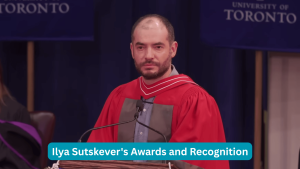
Sutskever’s reputation has been recognized by major scientific and technology institutions throughout his career.
| Year | Award or Recognition | Organization |
| 2015 | 35 Innovators Under 35 | MIT Technology Review |
| 2022 | Fellow of the Royal Society | The Royal Society |
| 2023 | TIME100 AI | TIME |
| 2024 | TIME100 AI | TIME |
| 2025 | Doctor of Science, honoris causa | University of Toronto |
The University of Toronto awarded Sutskever an honorary Doctor of Science in 2025 for his academic impact, AI leadership, and advocacy for safe and responsible AI.
His election to the Royal Society and repeated inclusion in TIME’s AI lists further reflect the influence of his research and leadership.
Ilya Sutskever’s Salary and Sources of Income
Salary is only one part of Sutskever’s financial story. His largest known source of wealth comes from equity. While working at Google, he received an offer worth about $6 million annually to remain with the company. He turned it down to join OpenAI.
His OpenAI equity later became worth billions, demonstrating the enormous difference between salary and founder-level ownership in a successful technology company.
SSI provides another potential source of wealth. Because the company’s ownership structure is private, however, the precise value of Sutskever’s personal stake cannot be established publicly.
His career therefore combines high-level research compensation with the far more powerful wealth-building mechanism of private-company equity.
Wrapping Up
Ilya Sutskever’s journey from an AI researcher to one of the industry’s most influential figures is a story of innovation, timing, and bold decisions. His work with Geoffrey Hinton, contributions to deep learning, and role in founding OpenAI shaped a career that reached far beyond academia. His reported OpenAI stake remains a major part of his financial success, while Safe Superintelligence represents his next ambitious venture. As you explore Ilya Sutskever net worth, it is important to consider both his existing equity and the future potential of SSI. His career continues to sit at the intersection of groundbreaking AI research, entrepreneurship, and the pursuit of safer advanced intelligence.
Frequently Asked Questions
Q1. What is Ilya Sutskever net worth?
His estimated 2026 net worth is $13.8 billion. The figure is primarily associated with his OpenAI equity and interests connected with Safe Superintelligence.
Q2. How much is Ilya Sutskever’s OpenAI stake worth?
Sutskever disclosed in May 2026 that his OpenAI stake was worth approximately $7 billion.
Q3. Is Ilya Sutskever a billionaire?
Yes. His reported OpenAI stake alone places him well above billionaire status on paper.
Q4. What is Safe Superintelligence Inc.?
SSI is an AI company co-founded by Sutskever in 2024. Its primary goal is to develop safe superintelligence rather than compete through conventional consumer AI products.
Q5. How much is SSI worth?
SSI was reportedly valued at approximately $32 billion following a $2 billion funding round in 2025.
Q6. Why did Sutskever leave OpenAI?
He left OpenAI in 2024 following the company’s 2023 leadership crisis and subsequently launched SSI with a stronger focus on safe superintelligence.
Q7. What did Sutskever do before OpenAI?
He worked at the University of Toronto, co-founded DNNResearch, and became a research scientist at Google Brain before joining OpenAI in 2015.